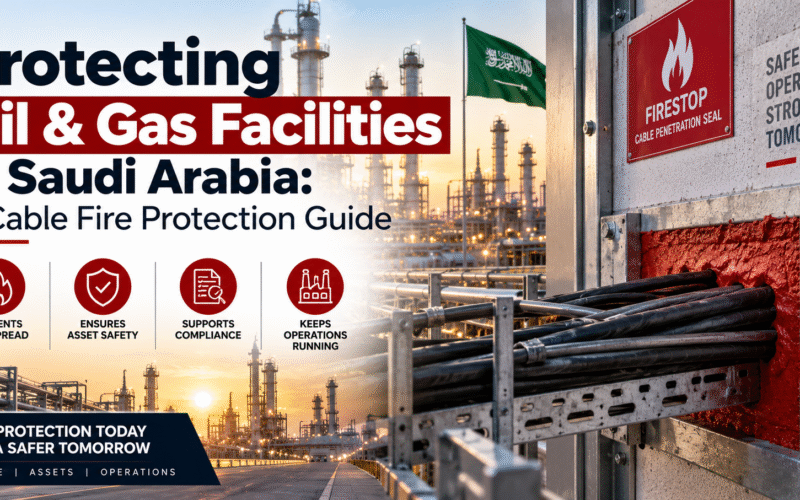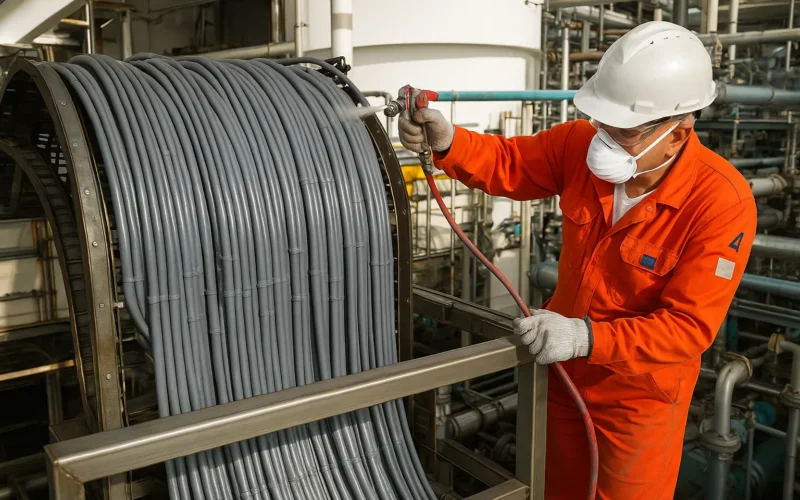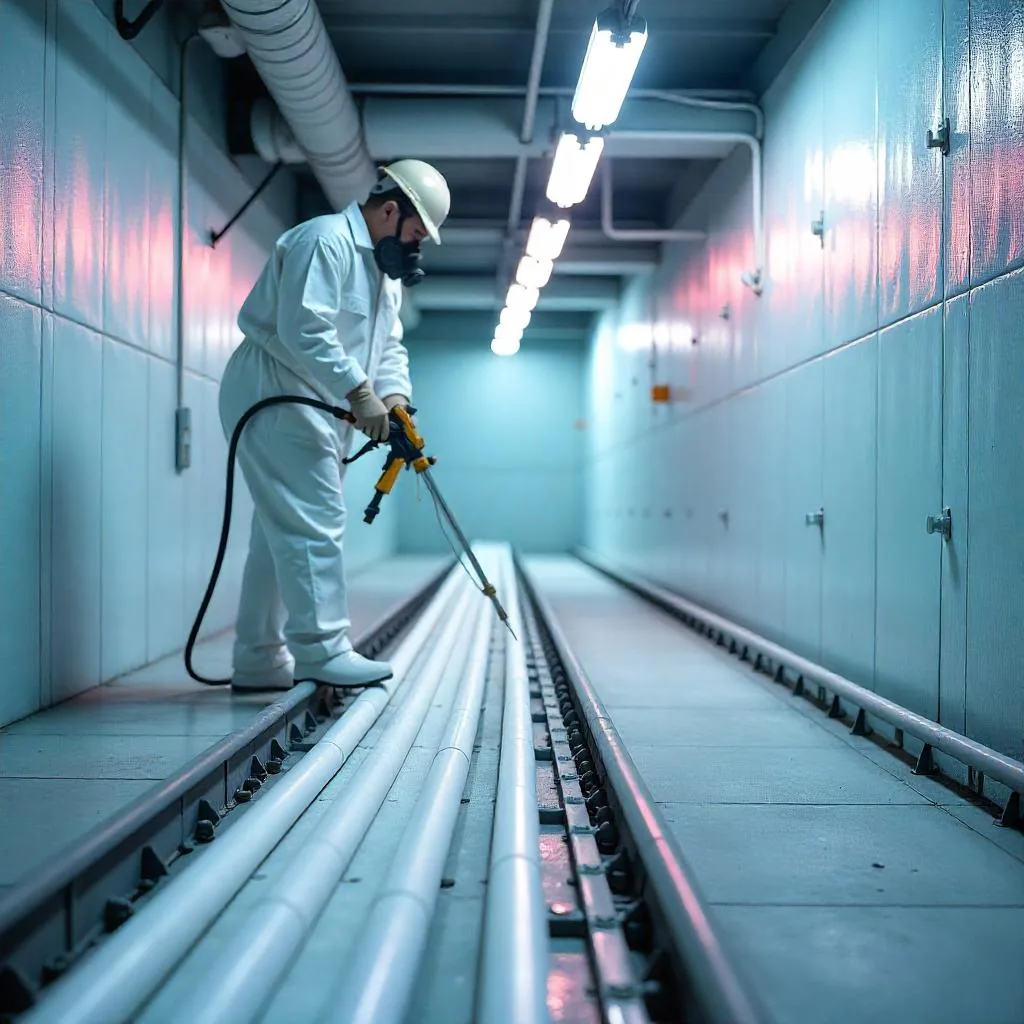
The Gulf is building data centres at a pace matched by few regions, and the fire engineering of those buildings is unusual. The rooms are full of cable — power to every rack, fibre and copper in overhead trays and under-floor voids, DC busway and battery cabling in the power rooms — and that cable is, in many data halls, the dominant fire load. At the same time the tolerance for smoke, water and downtime is close to zero. This article sets out how cable fire protection is specified for a Gulf data centre: which spaces need what, which standards apply, and the practical constraints — cleanliness, airflow, live operation — that shape the choice of product.
Why data centres are different
Three things set data centre cable protection apart. First, the fire load is distributed: instead of a few heavy trays in a basement, cable is everywhere, in trays above the racks, in the raised floor, in the risers between floors and in the power rooms. Second, the operating requirement is continuity: the fire strategy is built around early detection and clean-agent suppression precisely so that a fire does not become a fire, and passive protection has to work with that strategy rather than around it. Third, the environment is controlled: the halls are clean, cooled and pressurised, and anything applied to a cable must not shed particles, outgas, obstruct airflow or corrode equipment. Product selection for a data hall therefore begins with the environmental data sheet, not the fire test.
The spaces and what each needs
Data halls
Overhead and under-floor cable routes in the hall are protected for flame spread, so that a fault in one rack’s cabling does not travel along the tray and involve the next row. Low-smoke, halogen-free cable is normally specified for new halls; for existing halls with PVC-sheathed cable, a flame-spread coating on the trays provides the same control. The coating must be low-odour, non-particulating when dry and compatible with the clean-agent system; it must not fill the tray so that airflow under a raised floor is obstructed. Under-floor voids used as supply plenums are governed by plenum-cable rules in the applicable code, and the coating manufacturer should confirm suitability for plenum use.
Power rooms and battery rooms
UPS rooms, switchboards and battery rooms concentrate the power cable and are where fire is most likely to start. Trays are coated for flame spread, penetrations into the hall are firestopped, and the cables that feed the fire alarm, the suppression release, the emergency lighting and the controlled shutdown of the IT load are protected for circuit integrity — usually by fire-resistant cable, or by an intumescent coating system tested to IEC 60331 where existing cable is retained. Battery rooms bring a second hazard — thermal runaway in lithium-ion systems — and cable routes leaving them are generally protected to keep a battery fire from spreading into the power distribution.
Risers and interconnects
Vertical risers connect every floor and are the classic route for fire between compartments. Every riser tray is firestopped at each floor with a tested system that can be reopened, and the cable in the riser is coated for flame spread. Where diverse A and B feeds share a riser or a route, the fire strategy may require them to be separated by a rated enclosure or wrap so that a single fire cannot take out both — a point often missed when redundancy is designed for electrical failure rather than fire. Our comparison of coatings, wraps and enclosures covers how this separation is achieved.
Penetrations
Data centres have thousands of penetrations, and they change constantly as cable is added. Firestop systems are selected for re-enterability — pillows, re-enterable putty and board-and-sealant systems — and every penetration is recorded in a firestop schedule that operations can maintain. Our firestop sealants, mortars, boards and wraps include re-enterable systems for exactly this use.
Standards and frameworks
Cable flame spread in the hall is specified to IEC 60332-3 or IEEE 383 / IEEE 1202; circuit integrity for life-safety and shutdown circuits to IEC 60331; smoke and acid gas to the low-smoke halogen-free cable standards; firestopping to the tested system for each opening. The Saudi Building Code and Civil Defence approval apply as to any building, with the addition of the owner’s or operator’s own standards, and many Gulf data centres are designed to Uptime Institute tier requirements or to the Telecommunications Industry Association data centre standard, both of which address compartmentation and diverse routing. The approvals route is described in our guide to Saudi SASO and Civil Defence requirements, and the test standards in IEEE 383 and IEC 60331 explained.
Working in a live data hall
Retrofitting protection in an operating data centre is the most demanding version of live-facility work. Application is by brush or roller rather than spray; areas are tented and locally extracted; water-based, low-odour products are used; work is scheduled by row and by change window; detectors are managed with the operator’s change control rather than simply isolated; and the coated area is inspected and cleaned before the tenting comes down. The controls we apply in other operating plants are described in our retrofit article; in a data hall they are simply applied more strictly, and the method statement is agreed with the operator’s facilities and change-management teams before mobilisation.
What the specification should contain
- The fire strategy objective for each space: flame spread, circuit integrity and period, separation of diverse routes.
- The test standards, with the cable configuration and loading rate to be verified against the report.
- Environmental requirements: non-particulating, low-odour, compatible with the suppression agent, plenum suitability where relevant.
- Firestop system selection criteria, re-enterability and the requirement for a maintained firestop schedule.
- Method constraints for live areas and the records to be handed over.
Our technical specification development and compliance documentation services produce these clauses and the supporting submittal. If you are designing or operating a data centre in the Kingdom or elsewhere in the Gulf and want the cable protection scheme reviewed, contact us with the fire strategy and the cable routing drawings.
Frequently asked questions
Can cable coating be used in a raised-floor plenum?
Only a product confirmed by its manufacturer as suitable for plenum use, applied so that it does not obstruct airflow. Plenum-cable rules in the applicable code govern what may be installed in a supply plenum.
Will a coating affect the clean-agent suppression system?
Water-based coatings that are non-particulating when dry are compatible with clean-agent systems; the product data sheet should confirm it. Coating does not change the room integrity for agent retention, but firestopping penetrations improves it.
Is low-smoke halogen-free cable enough without coating?
For a new hall it usually satisfies the flame-spread and smoke requirements on its own. Coating is used on existing PVC-sheathed cable, on mixed routes and where an additional rating is required by the fire strategy.
How are diverse A and B feeds protected from a single fire?
By routing them in separate compartments where possible, and otherwise by enclosing or wrapping one route so that a fire on one cannot involve the other. The separation is stated in the fire strategy.
Can the work be done without shutting down racks?
Yes. Work is done by row within change windows, with tenting, local extraction, brush or roller application and detector management agreed with the operator.
Passive fire protection supplier and specialist contractor for electrical cable systems, based in Riyadh. Cable coating materials and application, firestop sealants and mortars, fire-resistant boards and wraps, and the technical documentation that goes with them.
Request a quotation
Send the cable schedule, tray routes, the fire rating required and any drawings. We propose the coating system and loading rate, supply the test and specification documentation, and price supply and application.