In a refinery or gas processing plant, the fire rarely starts in the cable trays. It starts somewhere else — a pump seal, a flange, a hot surface — and the cables are simply what carries it across the plant. A single tray run can travel through a substation, along a pipe rack, and into a control room. Once the insulation ignites, the fire has a ready-made path through areas that were never meant to be connected.
That is the real reason cable fire protection matters on oil and gas sites, and it is why plant engineers across the Kingdom start looking at coating options long before an audit forces the question.
What Cable Coating Actually Does
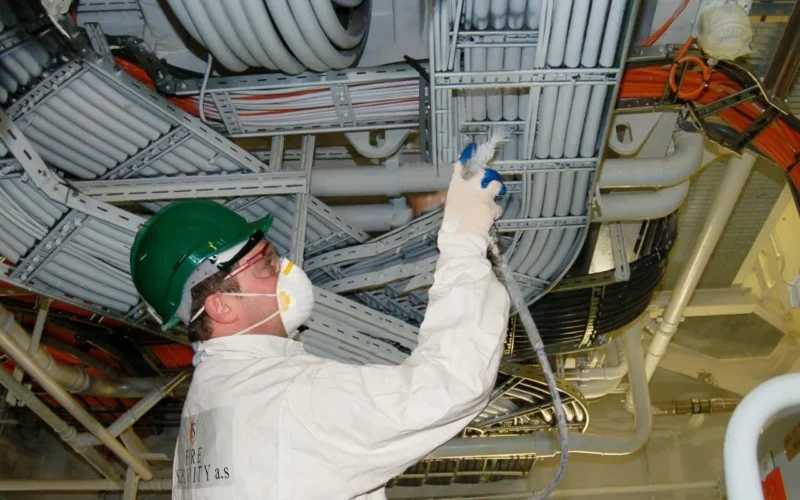
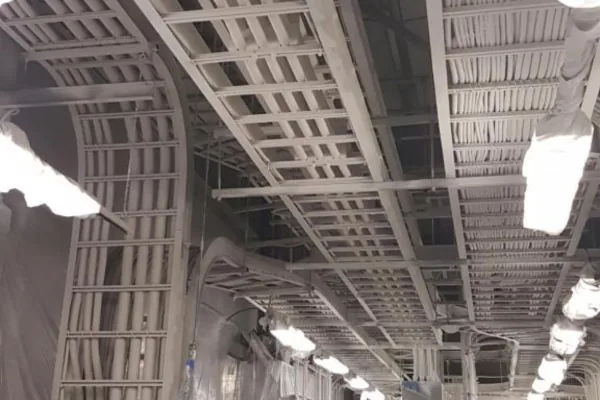
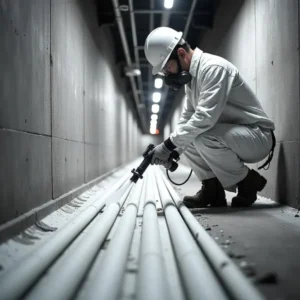
Cable coating is a passive fire protection treatment applied directly to the outer sheath of installed cables. Most systems used in the region are intumescent — under heat they expand and form an insulating char layer over the cable.
That char does two things. It slows flame propagation along the tray, so a localised fire does not become a plant-wide event. And it buys time for circuit integrity, keeping emergency shutdown systems, fire pumps, and detection loops running while the plant responds.
It is worth being clear about what coating is not. It does not make a cable fireproof indefinitely, and it does not replace fire-rated barriers, cable penetration sealing, or proper segregation of critical circuits. It is one layer in a passive fire protection strategy, not the whole strategy.
Why Oil & Gas Sites Are a Harder Case
Coating cable inside an office building and coating it inside a hydrocarbon facility are not the same job.
Facilities in the Eastern Province deal with heat, humidity, salt-laden air, and in many locations hydrocarbon vapour and process chemicals. A coating that cures well in a warehouse can chalk, crack, or lose adhesion within a couple of years in those conditions. Surface preparation matters more, product selection matters more, and so does the timing of the application.
There is also the shutdown problem. Live cable trays in an operating unit cannot always be accessed, which means the work has to be planned around a turnaround window with a realistic sequence and manpower plan. Contractors who have not worked inside a live plant tend to underestimate this badly.
Common Mistakes We See on Site
A few problems come up again and again on Saudi projects:
- Coating over dirt, oil, or dust. The film looks fine on day one and starts peeling within months. Cleaning the sheath is not an optional step.
- Wrong film thickness. Applying thinner than the product requires saves material and destroys the performance the coating was specified for. Thickness needs to be measured, not estimated.
- Ignoring the ends. Cables are coated along the tray but stop short at penetrations, glands, and junction boxes — exactly where fire finds a way through.
- No record of what was done. Without a route-by-route record, the next audit becomes guesswork.
- Treating everything equally. Emergency shutdown, fire detection, and safety-critical power circuits deserve priority over general lighting feeds.
What to Check Before Choosing a Cable Coating Company
Before you award the work, ask for the following:
- Product data sheets and test evidence for the exact coating being proposed — not a general catalogue.
- A method statement covering surface preparation, application method, film thickness, and curing time in your ambient conditions.
- Experience in operating facilities, including how the contractor handles permits, hot work restrictions, and shutdown windows.
- A survey before pricing. A quotation issued without a cable route survey is a guess, and guesses get revised upward mid-project.
- Inspection and handover documentation you can show to a client or an authority later.
If a contractor cannot answer these clearly, the risk moves to you.
How We Support Oil & Gas Clients
We provide cable coating services in Saudi Arabia for power plants, refineries, industrial facilities, data centres, and commercial buildings, working from a site survey through application to handover records. Alongside coating cable, we deliver related passive fire protection work — firestop sealing at penetrations, fire-resistant boards and wraps, and structural fireproofing — so a single scope covers the full fire path rather than one section of it.
Our team is based in Riyadh and works across the Kingdom, with material supply and application handled together to avoid the gap between what was specified and what actually goes on the cable.
Key Takeaways
Cable fire protection is about controlling how a fire travels, not just protecting the cable itself. On oil and gas sites, the environment and the shutdown constraints make execution quality the deciding factor. Choose a cable coating company on survey quality, method, and documentation rather than on rate alone.
If you are planning a turnaround or reviewing fire protection on an existing facility, a cable route survey is the practical first step. Our team can walk the site with you and put together a scope based on what is actually there.
Contact us : +966 56 562 7900, cablecoatingfireprotection@gmail.com
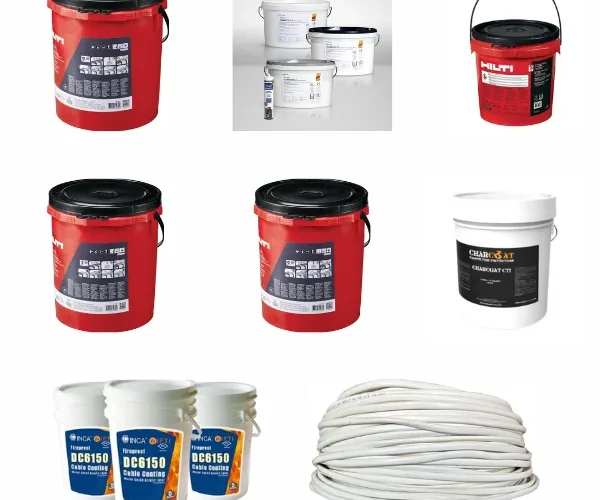
Our Products : To know more
Frequently Asked Questions
What is cable coating fire protection?
It is a coating applied to the outside of installed electrical cables that reacts to heat by forming an insulating char layer. The aim is to slow flame spread along cable routes and help critical circuits keep operating during a fire.
Is cable coating required in Saudi oil and gas facilities?
Requirements come from the project specification and the client’s own fire safety standards rather than a single universal rule. Most major operators specify passive fire protection for safety-critical cable routes; your project specification is the document to check.
Can cable coating be applied while the plant is running?
Sometimes, depending on access, permit conditions, and the area classification. In many units the work has to be scheduled into a shutdown or turnaround window. A site survey determines which routes can be done live.
How long does a cable coating system last?
It depends on the product, the film thickness applied, and the exposure. Coastal and process environments are harsher than indoor ones. Periodic visual inspection is the practical way to catch degradation before it matters.
Does coating cable affect its current rating?
Any material added to a cable affects heat dissipation, so derating should be checked against the cable schedule and the coating manufacturer’s guidance during design — not discovered after installation.
What is the difference between cable coating and firestopping?
Coating protects the cable along its route. Firestopping seals the openings where cables pass through walls, floors, and barriers. A facility generally needs both, and gaps between the two are where fires spread.
How do you price a cable coating job?
Pricing depends on the cable surface area to be coated, the required film thickness, access conditions, and the working window available. This is why a route survey should come before a quotation.
Do you supply the coating materials as well as apply them?
Yes — materials and application are handled together, which keeps responsibility for the specified performance in one place.
Passive fire protection supplier and specialist contractor for electrical cable systems, based in Riyadh. Cable coating materials and application, firestop sealants and mortars, fire-resistant boards and wraps, and the technical documentation that goes with them.
Request a quotation
Send the cable schedule, tray routes, the fire rating required and any drawings. We propose the coating system and loading rate, supply the test and specification documentation, and price supply and application.