The fire test report tells you what a cable coating can do. Whether it does it on your trays depends on the application. Coatings fail in service for mundane reasons — applied over dust, applied too thin, applied in one thick coat that never dried through, applied at midday on a rack in the sun — and every one of those is avoidable with a method that respects the product and the conditions. This is the method we use on site, set out step by step so that a contractor self-performing the work, or an engineer inspecting it, knows what good looks like.
1. Before the first pail is opened
Confirm the product, the loading rate and the number of coats from the test report and the specification, not from memory. Check the batch numbers and the shelf life. Read the data sheet for the ambient limits — surface temperature, humidity, recoat interval — and plan the shifts accordingly. Walk the route with the survey to confirm the areas, the access and the masking needed. Agree the measurement points and the record sheets with the inspector. On a retrofit, complete the permits described in our live-facility article.
2. Surface preparation
Cable jackets must be clean, dry and sound. Dust and loose deposits are removed by vacuum and brush; oil, grease and grime with a mild detergent solution and clean rags, followed by a clean-water wipe and full drying. Solvents are avoided on PVC and rubber jackets because they attack the sheath and leave residues that stop the coating bonding. Steel trays are cleaned of loose rust, oil and old paint; galvanised trays are degreased; bare steel is primed where the manufacturer requires it. Existing coatings are tested for adhesion with a cross-cut or a knife; sound compatible coatings may be overcoated, unsound ones are removed. Any damaged cable jacket is reported before it is covered.
3. Masking and protection
Mask cable glands, terminations, labels and identification markers so they remain readable; the specification may require labels to be re-fixed over the coating. Sheet switchgear, instruments, motors and floors against overspray and drips. Seal panel openings. Cover detectors or arrange isolation with a fire watch. In a data hall or a clean room, tent the work area with local extraction.
4. Mixing
Most cable coatings are single-pack water-based products supplied ready to use. Stir mechanically to a uniform consistency — pigments and fillers settle — but do not whip air into the product. Thinning is not normally permitted; where the data sheet allows a small addition of clean water for spray, it is measured and recorded, because thinning reduces the solids and therefore the dry film per coat. Keep pails closed and shaded; in summer, keep the product below 30 °C before use.
5. Application
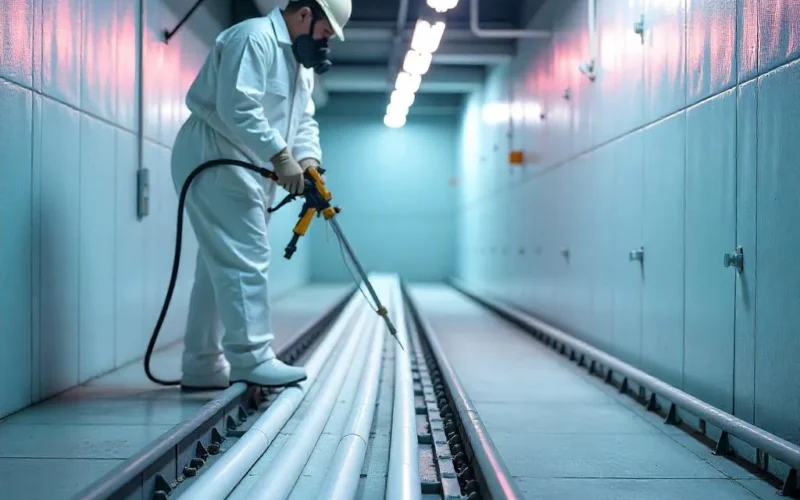
Airless spray is the method for long tray runs: fast, even and able to reach into the bundle. Tip size and pressure are set to the data sheet, and the spray is applied in passes from at least two angles so that the sides of the bundle and the gaps between cables are coated, not just the top. Brush and roller are used near live equipment, in confined spaces, on small sections and for touching in; brushing works the product into the bundle edges well but is slower and builds thinner films, so more coats may be needed to reach the loading rate. The tray rails and rungs are coated with the cables unless the system says otherwise. Each coat is applied to the wet-film thickness that corresponds to its share of the total loading rate — checked with a comb gauge as it goes — and no coat is applied thicker than the data sheet maximum, because an over-thick wet film skins over and traps water.
6. Coats and recoat intervals
The tested loading rate is normally reached in two or more coats. The recoat interval is the time the first coat needs to dry through before the next goes on, and it is the single most abused figure in cable coating application. In cool, ventilated conditions it may be a few hours; in a humid, unventilated cable basement it can be overnight or longer. Recoating too early traps water, and the result is a coating that blisters, cracks or stays soft for weeks. Test for through-dry with a thumb press — no marking, no cold feel — before the second coat, and record the interval actually used.
7. Drying and curing in Gulf conditions
Water-based coatings dry by evaporation, so they need air movement and a surface temperature within the data-sheet range, typically 5–45 °C, and they dislike both extremes found here. In a hot outdoor rack, apply early morning or at night, and shade the work; a film that skins in the sun dries from the outside in and never through. In a basement, provide temporary ventilation and dehumidification. Protect the coating from rain, wash-down and condensation until it is cured, which can take several days after it is touch-dry. Solvent-based topcoats or sealers, where the system requires them outdoors, are applied only after the base coats are through-dry.
8. Quality control
Wet-film gauge readings at agreed intervals during each coat; dry-film checks on completion by ultrasonic gauge, calibrated destructive cut or coated reference samples; material consumption reconciled against coated area; a visual inspection for holidays, sags, thin edges and uncoated undersides; and a photographic record of each area. The method and the numbers are explained in our article on loading rates and film thickness. Any area below the specified rate receives a further coat, measured and recorded.
9. Penetrations and handover
Where the coated tray passes through a wall or floor, the opening is sealed with the tested firestop system — the sealants, mortars, boards and wraps we supply are selected for each opening — and the coating is continued through the seal on both sides. The completion package contains the product data and test reports, the method statement, the measurement and consumption records, the firestop schedule, the photographs and an installer’s declaration. Our project management and implementation support service provides inspection and this documentation for contractors who apply the coating themselves, and our compliance documentation service assembles the submittal the consultant and Civil Defence will review.
If you would prefer us to apply the system, or to train and supervise your own crew on the first area, contact us with the tray schedule and the required rating.
Frequently asked questions
Can cable coating be sprayed?
Yes. Airless spray is the standard method for long tray runs, applied in passes from more than one angle to coat the sides and gaps of the bundle. Brush and roller are used near live equipment and for touch-in.
How many coats are needed?
As many as it takes to reach the tested loading rate without exceeding the data-sheet maximum wet film per coat — usually two or more. Each coat is measured with a wet-film gauge.
How long between coats?
Until the previous coat is through-dry, which depends on temperature, humidity and ventilation. It can be a few hours in good conditions or overnight in a humid basement. Recoating too early causes blistering.
Can the coating be applied in summer in Saudi Arabia?
Yes, with planning: early or night shifts outdoors, shading, cool storage of the product, and ventilation and dehumidification in enclosed spaces. Surface temperature must stay within the data-sheet range.
Can the cables be identified after coating?
Labels and markers are masked or re-fixed over the coating so that identification is preserved. The specification should say which is required.
Passive fire protection supplier and specialist contractor for electrical cable systems, based in Riyadh. Cable coating materials and application, firestop sealants and mortars, fire-resistant boards and wraps, and the technical documentation that goes with them.
Request a quotation
Send the cable schedule, tray routes, the fire rating required and any drawings. We propose the coating system and loading rate, supply the test and specification documentation, and price supply and application.