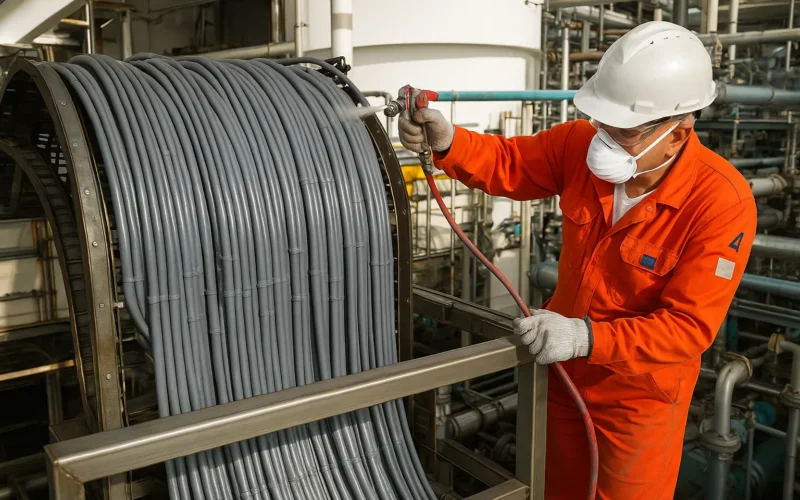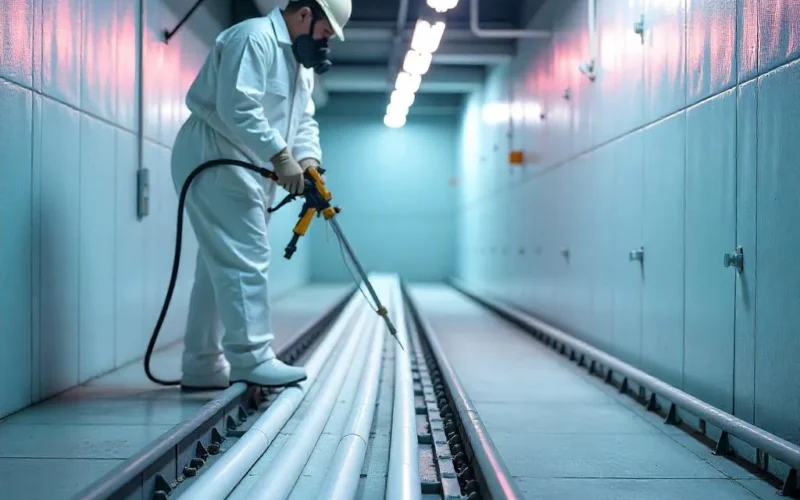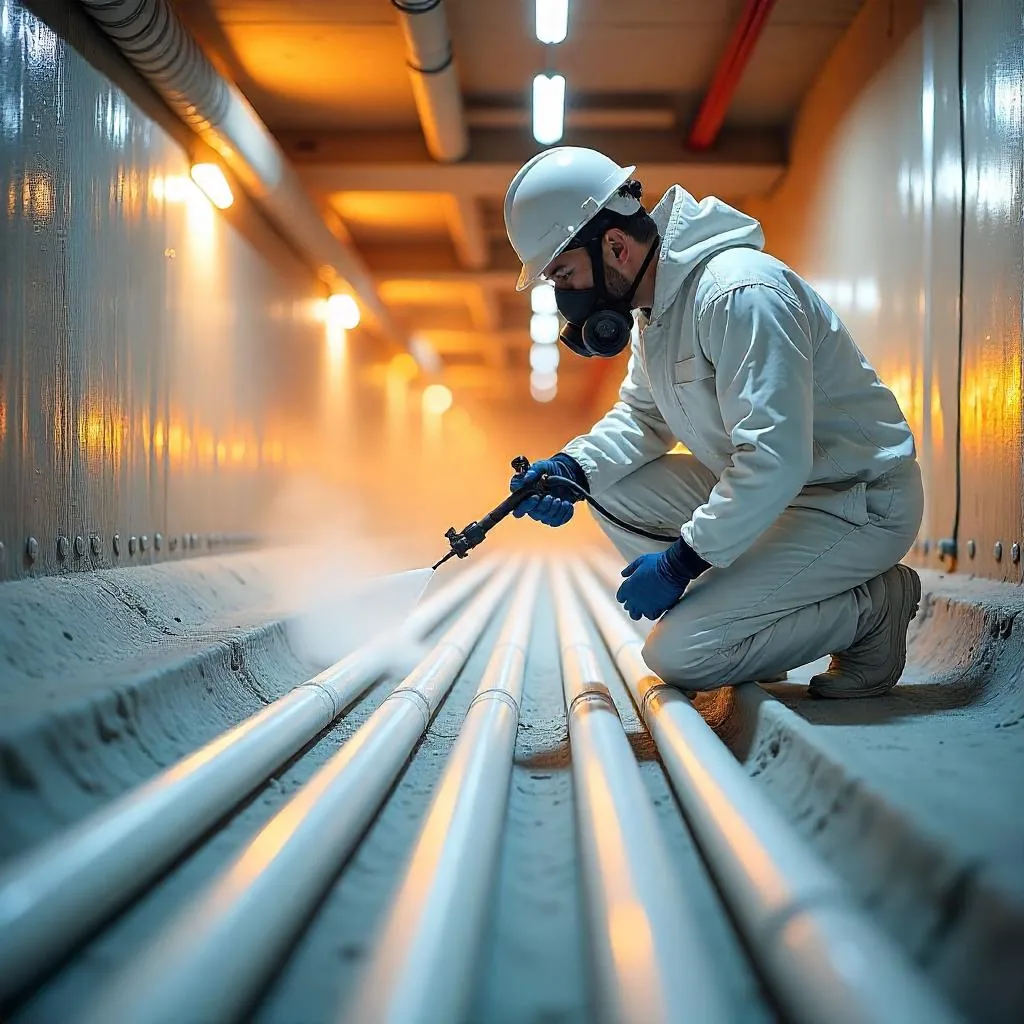
New-build cable coating is straightforward: the trays are empty of load, the rooms are clean and the programme has a slot for it. Almost none of our work is like that. The typical enquiry is an operating substation, a running process unit or an occupied building where an audit, an insurer or a Civil Defence inspection has found unprotected cable routes and the owner needs them protected without an outage. This article sets out how we plan and carry out cable coating in a live facility — the survey, the permits, the controls around live equipment, the sequencing and the records — so that an owner or a contractor knows what to expect and what to prepare.
Start with a survey, not a quotation
A retrofit cannot be priced from drawings, because the drawings are out of date. The survey walks every tray route to be protected and records the tray sizes, the fill, the condition of the cable jackets, the access — height, stacking, obstructions, live equipment nearby — the wall and floor penetrations and how they are currently sealed, and the environment: temperature, humidity, dust, oil contamination and whether the area is classified for explosive atmospheres. Photographs are taken at every change of condition. From this we produce the coated-area take-off, the loading rate for the required rating, the product selection and a method statement that reflects the real site. The survey usually takes a day for a substation and longer for a process unit.
Permits and controls
Live facilities run on permit-to-work systems, and the coating work is planned around them from the start:
- Live electrical work. Coating is applied to cable jackets, not conductors, and does not require de-energisation, but the applicators work within the facility’s safe-approach distances to live terminations and open panels. Panels are closed and sealed against overspray; near exposed live parts, brush or roller application replaces spray.
- Hot work and solvents. Water-based intumescent and ablative coatings contain no flammable solvent and normally do not require a hot-work permit, which is one of the main reasons they are chosen for retrofits. Where a solvent-based topcoat or sealer is needed — outdoor or chemically exposed areas — it is applied under a separate permit with gas testing where the area is classified.
- Confined spaces. Cable basements, trenches and tunnels are often confined spaces; entry, ventilation, gas monitoring and rescue arrangements are written into the method statement and the permit.
- Fire systems. Spraying near detectors can set them off. Detector isolation is agreed with the facility, a fire watch is maintained while detection is isolated, and the system is reinstated and tested at the end of each shift.
- Housekeeping. Overspray on switchgear, instruments or floors is a defect. Sheeting, masking and end-of-shift cleaning are part of the method, not an afterthought.
Sequencing by area
The work is broken into areas that can be isolated from the rest of the plant — one basement section, one riser, one tray run — and completed area by area, so that the facility never has more than a small zone affected at once and each zone is inspected and signed off before the next begins. Where trays run through occupied or continuously operated areas, night or weekend shifts are used. In a substation the sequence generally follows the order of fire risk: the openings under switchgear and the basement trays first, then the risers, then the outlying runs. In a process unit the sequence follows the fire zones in the hazard study, with the hydrocarbon-rated system areas first.
Application in Saudi conditions
Ambient conditions are the main technical difficulty. Water-based coatings need the surface temperature below the manufacturer’s maximum, typically 40–50 °C, and dry by evaporation, so in an unventilated cable basement at 45 °C with high humidity a coat can take considerably longer to dry than the data sheet suggests; in a sun-exposed outdoor rack in August it can skin over before it has flowed into the bundle. Practical measures include working early or at night outdoors, temporary ventilation and dehumidification in basements, keeping the product cool before use, and strictly observing the recoat interval — applying the second coat onto a first that is not through-dry traps water and leads to blistering. Full guidance is in our article on surface preparation and application.
Surface preparation on old cables is more work than on new. Dust, oil mist and old grime are removed by vacuuming and wiping with a detergent solution — never with solvents that attack the jacket — and any cable with a damaged jacket is reported to the owner before it is coated over. Existing coatings are checked for adhesion; a sound, compatible existing coating may be overcoated, an unsound one is removed.
Quality control and records
Every area is measured for wet-film thickness during application and dry-film thickness on completion, using the methods described in our article on loading rates and film thickness, and material consumption is tracked against the area coated. Each penetration sealed with a firestop system is recorded in a schedule with its location, opening, system and rating. Photographs before, during and after are kept for each area. The handover package contains the method statement, the product data and test reports, the measurement records, the firestop schedule and an installer’s declaration — the set the consultant, insurer and Civil Defence will want to see. Our project management and implementation support service runs this process for contractors who prefer to self-perform the application.
What the owner should prepare
To get a retrofit started quickly: the electrical single-line and cable schedule, the fire strategy or the audit report that triggered the work, the permit-to-work procedure and the induction requirements, the operating pattern of the areas concerned, and a nominated contact who can authorise isolations. With those, we can survey within days, return a fixed price for supply and application of the coating and firestop materials, and mobilise on the facility’s timetable.
Contact us to arrange a survey of an operating facility, or send the audit findings and we will scope the work from them.
Programme and cost drivers
Owners asking for a retrofit price usually want to know what moves it. On programme, the drivers are access and drying: trays at height or in confined basements take longer to reach and to ventilate, and every extra recoat interval adds a shift. On cost, the largest items are the coated area and the loading rate — a circuit-integrity or hydrocarbon rating uses two to three times the material of a flame-spread coating — followed by access equipment, the number of penetrations to be firestopped and the permit and shift constraints of the site. Night work, tenting, detector management and confined-space controls all add labour without adding material. A survey converts these into a fixed price; without one, any figure is an estimate that will change on site.
Frequently asked questions
Do the cables need to be de-energised for coating?
No. The coating is applied to the cable jacket and tray, and water-based products are non-conductive when dry and contain no solvent. Work near exposed live parts follows the facility’s safe-approach distances and uses brush or roller rather than spray.
Is a hot-work permit needed?
Not for water-based intumescent or ablative coatings. Solvent-based topcoats or sealers, where used, are applied under a separate permit with gas testing in classified areas.
How long is a substation basement affected?
The work is done in isolated sections, typically a few days per section including drying, so no more than one section is affected at a time and the switchgear stays in service throughout.
Can cables be added after coating?
Yes. New cables are laid on the coated bundle and then coated to the same loading rate. The specification should require this and the record should be updated.
What if an old cable has a damaged jacket?
It is reported to the owner before coating. Coating over damage hides it and does not repair it; the cable is repaired or replaced first and then coated.
Passive fire protection supplier and specialist contractor for electrical cable systems, based in Riyadh. Cable coating materials and application, firestop sealants and mortars, fire-resistant boards and wraps, and the technical documentation that goes with them.
Request a quotation
Send the cable schedule, tray routes, the fire rating required and any drawings. We propose the coating system and loading rate, supply the test and specification documentation, and price supply and application.