Passive fire protection on a Saudi project is approved on paper before it is inspected on site. The consultant reviews the submittal, the client’s loss-prevention engineer checks it against the company standard, and Civil Defence signs off the building against the Saudi Building Code — and every one of those reviewers asks the same question about a cable coating: what is the evidence that this product, applied this way, meets this requirement? This article explains the regulatory framework for cable fire protection in the Kingdom, what SASO and Civil Defence actually require, and what a compliant submittal contains. It is written as practical guidance; the code and the authority always take precedence over any summary.
The three layers
The Saudi Building Code (SBC). The SBC fire code sets the requirements for compartmentation, fire-resistance ratings of walls and floors, protection of penetrations and the survivability of emergency systems. It is based on the International Building Code and International Fire Code, adapted for the Kingdom, and it is the document Civil Defence enforces. Cable fire protection enters the SBC in three places: firestopping of penetrations through rated assemblies, the requirement that emergency circuits — fire pumps, alarm, smoke control, emergency lighting — survive for a defined period, and the general control of combustible materials in concealed spaces and plenums.
SASO conformity. The Saudi Standards, Metrology and Quality Organization regulates products placed on the Saudi market. Imported fire protection products pass through the SABER conformity platform, where the importer registers the product, and depending on its category obtains a product certificate of conformity and a shipment certificate against the applicable Saudi or international standard. For cable coatings and firestop materials the relevant technical evidence is test reports from accredited laboratories to the standards named in the specification — IEC, IEEE, UL, FM, ASTM or BS — and the conformity certificate confirms that the product as imported is the product that was tested.
Civil Defence approval. The General Directorate of Civil Defence approves the fire safety design of the building, inspects it at completion and issues the fire safety certificate needed for occupancy. Its reviewers check the passive fire protection against the approved drawings, ask for the test evidence and the installation records and, increasingly, expect to see the firestop schedule and the cable protection scheme as a defined part of the submittal rather than something buried in the electrical package.
What the inspector asks for
In our experience the documents requested at review and at inspection are consistent:
- the manufacturer’s technical data sheet and safety data sheet for each product;
- fire test reports from an accredited laboratory, to the standard named in the specification, showing the cable configuration, loading rate and result;
- the SASO / SABER conformity certificate for the imported product;
- a method statement for application, including surface preparation, loading rate control and measurement;
- a firestop schedule listing every penetration, the tested system used and its rating;
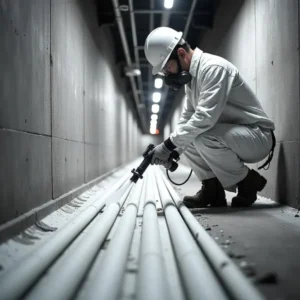
- completion records: wet-film and dry-film measurements, material consumption, photographs and an installer’s declaration;
- marking or labelling of protected routes and sealed penetrations on site.
The single most common reason a submittal is returned is a mismatch between the specification and the evidence: a coating specified for circuit integrity but supported only by a flame-spread test, or a firestop system used on an opening size or a wall type outside its tested scope. Our article on IEEE 383 and IEC 60331 explains the difference that causes the first of these.
Client standards on top of the code
Most large Saudi projects are built for an owner with its own engineering standards — Saudi Aramco, SEC, SABIC, Ma’aden, the Royal Commission, NEOM and others — and those standards sit above the SBC minimum. They commonly name the test routes accepted for cable trays, require hydrocarbon fire ratings in process areas, set the fire-resistance period for emergency circuits, restrict certain materials, and require vendor approval or pre-qualification of the product. A submittal that satisfies the code but not the client standard will still be rejected, so the specification should be written against both. This is the core of our technical specification development work: reading the client standard and the code together and producing a clause set that a supplier can meet and an inspector can verify.
Neighbouring Gulf authorities
Contractors working across the region meet similar frameworks elsewhere: the UAE Fire and Life Safety Code of Practice administered by the Civil Defence in each emirate, Qatar Civil Defence requirements under QCDD, and Bahrain Civil Defence. The evidence expected is much the same — accredited fire test reports, product approval and installation records — and a submittal package prepared to the Saudi standard will usually translate with limited additional work. We prepare packages for all four jurisdictions.
Getting a system approved on a project
The sequence that works is: confirm the required ratings from the fire strategy and the client standard; select a product with test evidence for exactly that requirement; check the SASO conformity status of the product before it is ordered; submit the data sheet, test report, conformity certificate and method statement together; hold a pre-application meeting with the consultant and, where the client requires it, a trial area; apply with measurement records; and hand over a completion package with the firestop schedule and the records. Our regulatory compliance documentation service produces the submittal and the completion package, and our project management and implementation support manages the approval sequence for the contractor. The products we supply are selected and stocked with this evidence already in hand.
If a cable protection submittal has been returned, or you want the evidence package assembled before you submit, send us the specification and the reviewer’s comments and we will tell you what is missing.
Common submittal mistakes
Beyond the specification-evidence mismatch, the same errors recur. Test reports are submitted for a product name that differs slightly from the one on the conformity certificate or the delivery note — a reformulated or regionally rebranded product — and the reviewer has no way to confirm they are the same material. Reports are submitted without the appendix that gives the loading rate and the cable configuration, so the reviewer cannot check the applied rate. Firestop systems are proposed by product rather than by tested system, so there is no evidence for the specific wall type and opening. Method statements describe the product but not the measurement and record-keeping. And the completion package is assembled at the end from memory rather than built during the work. Each of these is avoidable by treating the submittal as a document set that is checked against the specification line by line before it goes to the consultant, which is the service we provide.
Frequently asked questions
Does Saudi Civil Defence approve individual cable coating products?
Approval is given to the building’s fire safety design and installation, supported by product evidence. The evidence — accredited test reports and SASO conformity — is reviewed as part of the project submittal rather than as a stand-alone product listing.
What is SABER and does a cable coating need it?
SABER is the SASO conformity platform through which imported products are registered and certified. Fire protection products imported into the Kingdom pass through it; the certificate confirms the imported product matches the tested one.
Which standards does the Saudi Building Code accept for cable fire tests?
The SBC references international test standards; in practice both the IEC route (IEC 60332, IEC 60331) and the IEEE / UL route (IEEE 383, IEEE 1202, UL 1709) are accepted with accredited evidence. Client standards may specify one.
What records must be kept after application?
Wet-film and dry-film measurements, material consumption against area, photographs, the firestop schedule and an installer’s declaration. These form the completion package the consultant and Civil Defence review.
Do the same rules apply in the UAE, Qatar and Bahrain?
Each has its own Civil Defence framework, but the evidence expected — accredited test reports, product approval and installation records — is closely similar, and a Saudi-standard submittal usually needs only modest adaptation.
Passive fire protection supplier and specialist contractor for electrical cable systems, based in Riyadh. Cable coating materials and application, firestop sealants and mortars, fire-resistant boards and wraps, and the technical documentation that goes with them.
Request a quotation
Send the cable schedule, tray routes, the fire rating required and any drawings. We propose the coating system and loading rate, supply the test and specification documentation, and price supply and application.