Substations and switchgear rooms concentrate more cable per cubic metre than any other part of a facility. Cable basements, trenches and risers carry hundreds of power and control cables in tightly packed trays, and a fault in one of them — an overheated joint, a failed termination, a rodent-damaged jacket — starts a fire with an unlimited supply of fuel running in every direction. The consequence is rarely the fire itself; it is the loss of the substation, and with it everything downstream. This article explains where these fires start, which circuits have to survive them, and how coatings, firestop and layout are combined to keep a single cable fault from becoming a plant outage.
Where substation cable fires start
Fire investigations in electrical rooms return the same causes repeatedly: overheating at terminations and joints, insulation breakdown in aged cables, overloaded circuits, arcing at damaged jackets, and — in the Gulf — fires spreading into the cable basement from outside. The location is almost always the point where cables are most concentrated: the trench under the switchgear, the vertical riser, the tray entering the panel. Once the jacket of one cable is burning, flame travels along the bundle, and unprotected PVC-sheathed cables in a packed tray can carry a fire the length of a basement in minutes, generating dense, corrosive smoke that damages switchgear well beyond the fire zone.
Two objectives, two treatments
Protection in a substation has two distinct objectives. The first is to stop flame spreading along the trays and through the walls — the compartmentation objective. The second is to keep specific circuits alive during the fire: the DC supply to protection relays and trip coils, the fire detection and suppression, the emergency lighting, the auxiliary supplies to the fire pumps and the control cables that allow the plant to be shut down safely. The first objective applies to every tray; the second applies to a defined list of circuits identified by the protection and control engineer.
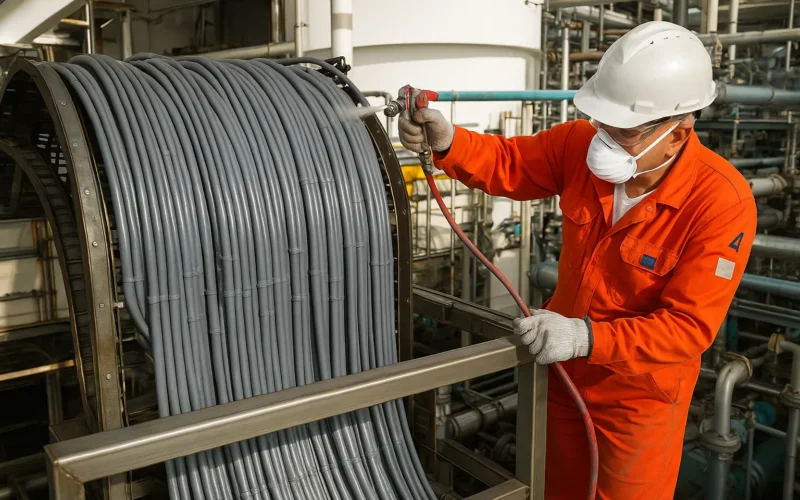
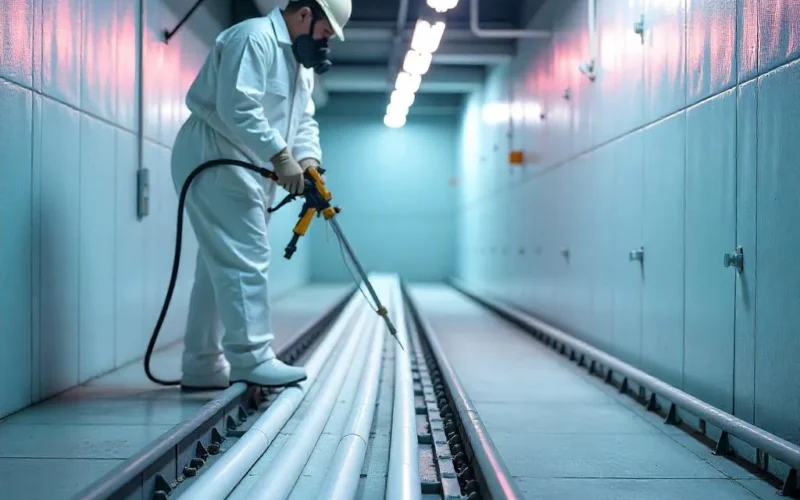
For flame spread, a coating tested to IEC 60332-3 Category A or IEEE 383 / IEEE 1202 on bunched cables is applied to the trays in the cable basement and risers, with particular attention to the tray sections entering panels and passing through walls. For circuit integrity, the designated cables are either replaced with fire-resistant cables or protected with an intumescent cable coating system tested to IEC 60331 for the required period, or enclosed in fire-rated boards or wraps where they run through areas of high fire load. The difference between these standards is explained in our guide to IEEE 383 and IEC 60331.
Coating trays in an electrical room
Substation trays present specific practical issues:
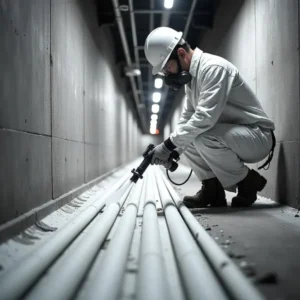
- Fill and access. Basement trays are often full and stacked. The coating must be applied to the exposed surfaces of the bundle and worked into the edges; where trays are stacked too closely to reach, the specification should require the lower tray to be coated from below.
- Heat dissipation. Power cables in a substation run warm. The coating adds a thin thermal layer and a derating allowance is applied — small for thin intumescent films, but it must be checked against the cable sizing calculation, particularly for main incomers.
- Cleanliness and live working. Rooms are usually live during the work. Water-based coatings with no flammable solvent are preferred, panels are sealed against overspray, and brush or roller application is used near live equipment. The method is set out in our article on retrofitting in a live facility.
- Future additions. Substations grow. The specification should require any new cable added to a coated tray to be coated, and the coating record kept with the substation drawings.
Penetrations and the wall
A coated tray that passes through an unsealed wall opening is a fire path. Every tray, conduit and cable penetration through the fire-rated walls and floors of the electrical room — and especially the openings under the switchgear into the cable trench — must be sealed with a tested firestop system. For trays this usually means a fire-rated mortar, pillows or a board-and-sealant system that can be reopened when cables are added; for the large openings under panels, boards or mortar with a fire-rated coating over the cables on both sides. Our firestop sealants, mortars, boards and wraps are selected to match the opening and the rating of the wall, and the coating and the firestop are documented as one system at the penetration.
Cable basements and trenches
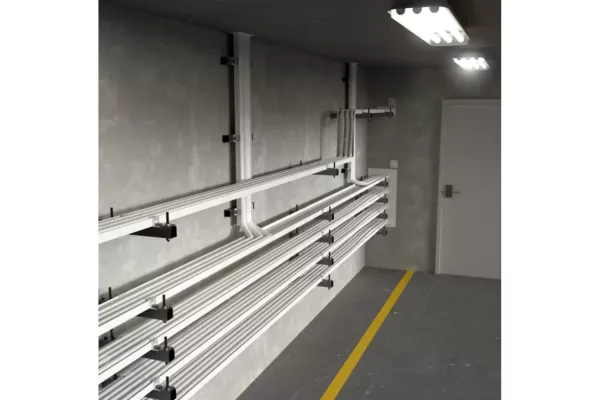
Below the switchgear, the cable basement or trench is the most important zone. It holds every cable in the building, it is difficult to reach in a fire, and it is where fires from outside — a transformer or an oil-filled cable — enter. Best practice combines a flame-spread coating on all trays, fire barriers across the basement at intervals and at the boundary of each switchgear section, firestopped penetrations up into the panels, and detection in the basement itself. Fire barriers in a basement are commonly built from fire-resistant boards fixed to a frame, with the trays passing through sealed openings; this compartments the basement so that a fire under one section does not reach the next.
Saudi requirements
SEC, Aramco and the Saudi Building Code each address electrical room fire protection, and Civil Defence expects to see the firestopping of penetrations and the protection of cable routes in the fire safety documentation for the building. Client standards may require specific test routes — IEEE 383 for trays and IEC 60331 for fire-rated circuits are common — and the test evidence for the coating and firestop products is submitted for approval before the work begins. Our regulatory compliance documentation service assembles that submittal, and the wider approval process is covered in our Saudi SASO and Civil Defence guide.
If you are responsible for a substation, a switchgear building or a cable basement and want the trays and penetrations surveyed and a protection scheme priced, contact us with the single-line diagram and the cable schedule, or simply arrange a site visit.
A typical protection scheme
For a medium-voltage substation with a cable basement, the scheme we most often propose has five parts. All basement and riser trays receive a flame-spread coating tested on bunched cables, including the tray rails and the sections entering the panels. The openings under every switchgear cubicle into the basement are sealed with a re-enterable board or mortar system with fire-rated coating on the cables either side. Fire barriers of fire-resistant board divide the basement at the boundaries of each switchgear section and at intervals along long runs. The DC, protection, fire detection and emergency lighting circuits identified by the protection engineer receive a circuit-integrity coating to IEC 60331 or are wrapped or enclosed where they pass through high-risk areas. And every wall and floor penetration out of the electrical rooms is firestopped and entered in a schedule. Priced together, the coating is usually the largest item and the firestopping the most detailed, and the whole scheme is normally installed with the substation live over a few weeks of sectional working.
Frequently asked questions
Should every tray in a substation be coated?
Trays in the cable basement, trenches and risers — where cables are concentrated and a fire would spread — are normally coated for flame spread. Trays in open, low-density areas may be addressed by firestopping and separation instead. The fire risk assessment decides.
Which circuits need circuit-integrity protection?
Those that must keep working during a fire: DC supplies to protection and tripping, fire detection and suppression, emergency lighting, fire pump auxiliaries and safe-shutdown controls. The protection and control engineer identifies them.
Can cable coating be applied in a live substation?
Yes, with a method statement covering live-working distances, sealing of panels, water-based products and brush or roller application near equipment. We do this routinely.
Does coating reduce the current rating of substation cables?
A small derating allowance is applied for the coating’s thermal effect. It is checked against the cable sizing calculations, particularly for heavily loaded incomers and feeders.
How are the openings under switchgear sealed?
With a tested firestop system suited to large openings — fire-rated boards or mortar, with pillows or sealant around individual cables — chosen so that the seal can be reopened for future cables.
Passive fire protection supplier and specialist contractor for electrical cable systems, based in Riyadh. Cable coating materials and application, firestop sealants and mortars, fire-resistant boards and wraps, and the technical documentation that goes with them.
Request a quotation
Send the cable schedule, tray routes, the fire rating required and any drawings. We propose the coating system and loading rate, supply the test and specification documentation, and price supply and application.