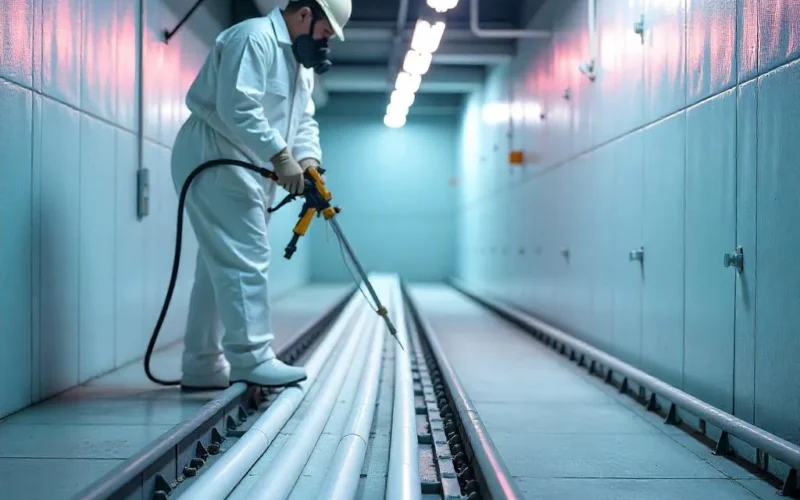
The most common cause of a cable coating failing an inspection is not the product. It is the amount of it. A coating that was tested at 2.5 kg/m² and applied at 1.2 kg/m² has no tested performance at all, and the shortfall is invisible once the coating has dried unless someone measured it. This article explains how the thickness of a cable coating is specified, how the different figures — loading rate, wet film, dry film, coverage — relate to each other, and how to check them on a real cable tray in Riyadh in August rather than on a flat panel in a laboratory.
Why thickness is the rating
Both intumescent and ablative coatings protect by mass. An intumescent film expands to a char whose insulating value depends on how much material there was to expand; an ablative film absorbs heat in proportion to the quantity of material available to be consumed. The fire test that produced the rating was carried out at a specific application rate, and the rating belongs to that rate. There is no proportional credit for a thinner film — a coating at 70 % of the tested rate is not 70 % as good, it is untested. This is why every reputable test report states the loading rate alongside the result, and why the specification should require it to be verified. Our article on intumescent versus ablative coatings explains the two mechanisms in more detail.
The four figures and how they relate
Loading rate
The mass of wet coating applied per unit area of cable surface, in kg/m². This is the figure most cable coating test reports use because it is what the laboratory measured — the coated tray was weighed before and after. Typical loading rates for tray coatings range from around 1.5 kg/m² for a flame-spread system to 3–5 kg/m² or more for circuit-integrity and hydrocarbon systems, applied in two or more coats.
Wet film thickness (WFT)
The thickness of the coating immediately after application, measured with a comb gauge pressed into the wet film. Loading rate and wet film are linked by the density of the product: at a density of about 1.3 kg/l, 2.6 kg/m² corresponds to 2 mm of wet film. WFT is the figure the applicator checks during the job because it can be corrected immediately.
Dry film thickness (DFT)
The thickness after the water or solvent has left. Water-based cable coatings lose 30–45 % of their volume on drying, so a 2 mm wet film becomes a 1.1–1.4 mm dry film. DFT is what the inspector measures at the end with a gauge or a destructive check, so the specification must state either the DFT target or the volume solids that convert WFT to DFT.
Coverage
The area a given quantity of product will cover at the specified rate, usually stated in m²/kg or m²/litre. It is the reciprocal of the loading rate and is the figure the estimator uses to order material. A 25 kg pail at 2.5 kg/m² covers 10 m² of cable surface — before wastage.
Cable surface area is not tray area
The number that trips up most estimates is the area to be coated. It is the surface area of the cables, not the plan area of the tray. A tray 600 mm wide with a single layer of 30 mm cables laid side by side has a cable surface area — top, sides and the visible parts of the underside — of about 1.5 to 2 times the tray area; a tray filled several layers deep is coated over the exposed outer surface only, but the coating must be worked into the gaps between cables at the edges. Manufacturers publish tables converting tray width and fill to coated area, and our estimators use them, but on an existing installation nothing beats measuring the trays and photographing the fill. The rungs and side rails of a steel tray are usually coated as well, both for continuity and because unprotected steel conducts heat into the cable bundle.
How to measure on site
- During application: wet-film comb gauge at agreed intervals — every few metres of tray and at every change of fill or orientation. The applicator records the reading, location and time. A second coat is applied only after the first has dried and been checked.
- On completion: dry film thickness by a gauge suitable for the substrate (a cable jacket is non-metallic, so magnetic and eddy-current gauges cannot be used directly; ultrasonic gauges or a calibrated destructive cut on a sacrificial coated cable sample are the usual methods). Coated test panels or short cable offcuts, coated alongside the tray, give a reliable and non-destructive reference.
- By mass: where the tray area is known, the quantity of material consumed divided by the area is a useful cross-check against the loading rate. A job that consumed 40 % less product than the estimate has almost certainly been applied thin.
Estimating material
A workable estimate follows five steps: measure the tray length and width for each run; convert to cable surface area using the manufacturer’s fill table; multiply by the tested loading rate for the required rating; add wastage — 10 % on straight runs, 20–25 % where there are many bends, drops and penetrations, and more for spray application in the open air; and round up to whole pails. Then add the ancillary items: primer where the manufacturer requires it on bare steel tray, reinforcing mesh for hydrocarbon systems on wide trays, and the firestop sealants and mortars for wall and floor penetrations, which are estimated separately by opening size.
Thickness and the specification
A specification clause that can be enforced states the tested loading rate in kg/m², the equivalent DFT, the number of coats, the measurement method and frequency, and the records to be kept. It should also say what happens to areas found thin: an additional coat to bring the total to the specified rate, re-measured and recorded. Our technical specification development service writes these clauses, and our project management and implementation support provides the site inspection and the completed records at handover. Application practicalities — surface preparation, ambient conditions, drying times between coats — are covered in our guide to surface preparation and application.
If you would like a material estimate for a specific installation, send us the tray schedule — lengths, widths, fill and the fire rating required — and we will return a quantity and a price for supply, or supply and application.
Frequently asked questions
What is a typical dry film thickness for cable coating?
It depends entirely on the product and the rating. Flame-spread systems are often around 1 mm dry; circuit-integrity and hydrocarbon systems are thicker, applied in two or more coats to the loading rate in the test report. Use the tested figure, not a rule of thumb.
Can dry film thickness be measured on a cable with a magnetic gauge?
No. Cable jackets are non-metallic, so magnetic and eddy-current gauges have nothing to reference. Ultrasonic gauges, calibrated destructive cuts on sacrificial samples or coated reference panels are used instead.
Why is the coverage on the data sheet higher than what the job used?
Data sheet coverage is theoretical, on a smooth surface with no wastage. Cable bundles have a larger surface than their footprint, and spray application in the open loses material. Allow 10–25 % wastage depending on the job.
Do the tray rails and rungs need coating?
Usually yes. Unprotected steel conducts heat into the bundle and interrupts the char. The manufacturer’s system data will say whether the tray is coated and whether a primer is needed on bare steel.
What if the coating was applied too thin?
An additional coat is applied to bring the total to the specified loading rate, after the existing coat has been checked for adhesion. The extra coat is measured and recorded like the original.
Passive fire protection supplier and specialist contractor for electrical cable systems, based in Riyadh. Cable coating materials and application, firestop sealants and mortars, fire-resistant boards and wraps, and the technical documentation that goes with them.
Request a quotation
Send the cable schedule, tray routes, the fire rating required and any drawings. We propose the coating system and loading rate, supply the test and specification documentation, and price supply and application.