Most fire tests assume a fire that grows. The standard cellulosic curve used in building-fire tests climbs through 500 °C in the first five minutes and reaches around 830 °C only after half an hour. A hydrocarbon fire does not behave like that. A ruptured line or a pool of burning condensate produces a fire that is at 1100 °C within five minutes and stays there. Cable protection that was tested to the slow curve has never been exposed to those conditions, and a specification that quotes it for a process area is specifying evidence that does not apply. This is the reason UL 1709 exists, and the reason a hydrocarbon fire rated coating system is a different product from a general-purpose one.
The hydrocarbon fire curve
UL 1709, “Rapid Rise Fire Tests of Protection Materials for Structural Steel”, defines a furnace time–temperature curve that reaches 1093 °C (2000 °F) within five minutes and holds it for the duration of the test, with a specified heat flux of around 204 kW/m². It was developed for the protection of structural steel in refineries and petrochemical plants, and its curve — together with the closely related hydrocarbon curves in BS 476 Part 20 Appendix D and in ISO and EN standards — is the reference for any passive fire protection in a hydrocarbon fire zone. For cable protection the relevant tests borrow the same curve: the coated cable or tray is exposed to a rapid-rise fire and its circuit integrity or flame spread is measured under those conditions rather than under a building fire.
Two things distinguish the hydrocarbon exposure from the cellulosic one. The thermal shock in the first minutes is far more severe — an intumescent char that formed comfortably in a slow furnace can be blown or eroded off before it has developed. And the sustained temperature, 1100 °C continuous, is above the operating range of many coatings that perform well at 830 °C.
What a hydrocarbon-rated coating has to do
A coating specified for a hydrocarbon fire zone is expected to maintain the protected cable below its failure temperature for a defined period — commonly 60 to 90 minutes — while the fire is at 1100 °C. That demands a formulation that can withstand the initial thermal shock, remain adhered to the cable and tray through the rapid expansion, and continue to insulate through the sustained exposure. In practice this means thicker films, higher loading rates than a general-purpose intumescent, sometimes reinforcing mesh on larger trays, and always a product whose test report shows the hydrocarbon curve rather than the standard one.
The systems we supply for these zones are specified and tested for 1100 °C continuous exposure with 60–90 minute protection periods to the UL 1709 curve. The loading rate and the number of coats come from the test report and are not negotiable on site: a hydrocarbon rating is a function of coating mass, and reducing it removes the rating.
Where hydrocarbon fire zones are
The zone is defined by the fire hazard, not by the industry. Any location where a pool, spray or jet fire of flammable liquid or gas is credible is a hydrocarbon fire zone, which typically includes:
- process units, pipe racks and pump areas in refineries and gas plants;
- tank farms, loading bays and product pipelines;
- offshore platforms and FPSO modules;
- compressor stations, gas turbine enclosures and fuel-gas systems in power generation;
- petrochemical and fertiliser plants, and the utilities feeding them.
On most sites the fire hazard study or the project fire and explosion risk assessment identifies these zones and assigns the fire exposure and duration. Cables that must keep functioning during that exposure — emergency shutdown, fire and gas detection, fire pump power, depressurisation valves — need protection rated for it. The cables that merely need to not spread fire may be adequately protected by a flame-spread coating.
Jet fires
A jet fire — ignited high-pressure gas release — is more severe still. Its flame temperature is comparable to a pool fire but it delivers far higher heat flux and a strong erosive force. UL 1709 does not represent a jet fire; jet-fire performance is tested separately to ISO 22899-1 and reported as an addition to the hydrocarbon rating. If the risk assessment identifies jet-fire exposure for a cable route, specify the jet-fire test as well and expect a different, heavier system.
Specifying a hydrocarbon-rated cable coating
The specification needs to say five things: the fire curve (UL 1709 or the equivalent hydrocarbon curve), the protection period, the acceptance criterion (circuit integrity or flame spread), the cable and tray configuration to be protected, and the requirement that the loading rate be that of the test report and verified on site. It should also state the environmental exposure — coastal, sour-gas, wash-down — because a coating that survives the fire but fails after two years of salt spray is not a solution. Our technical specification development and regulatory compliance documentation services exist to turn the fire hazard study into clauses of exactly this kind, and to assemble the evidence package the client’s loss-prevention engineer and Civil Defence will review.
Application in process areas
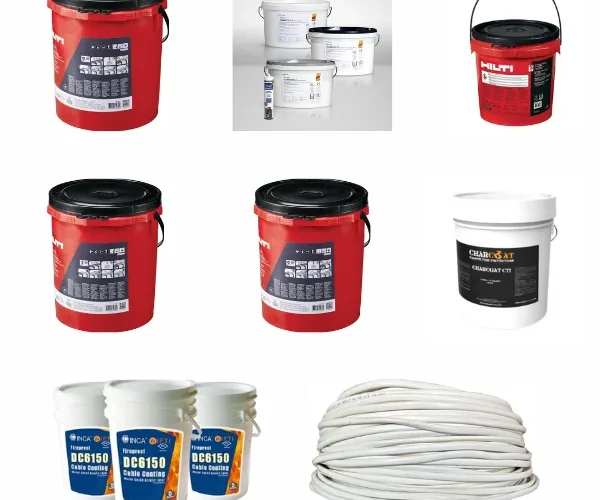
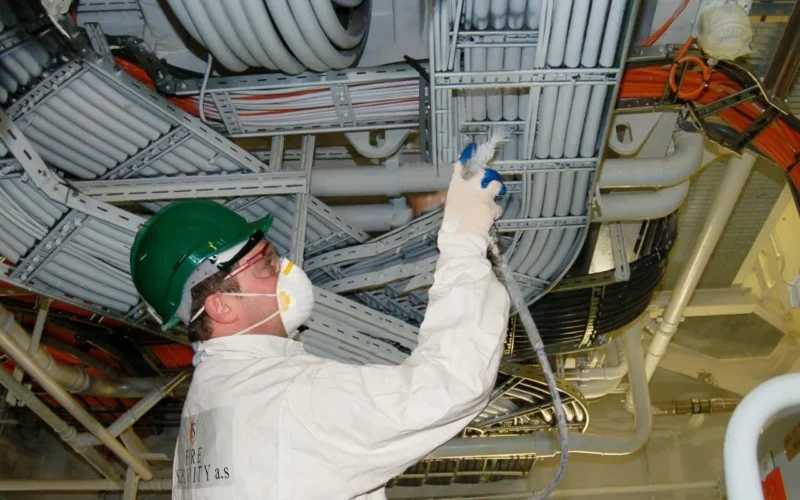
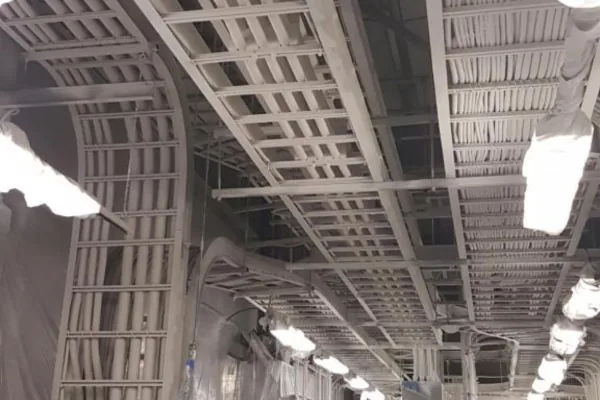
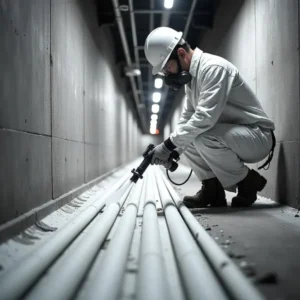
Hydrocarbon-rated systems are applied at higher build than general-purpose coatings and often in areas that cannot be shut down. The method statement matters as much as the product: hot-work permits, solvent management, curing times in Saudi summer temperatures, and protection of the coating from process spillage while it cures. We cover the practicalities in our article on retrofitting cable coating in a live facility. Our product range includes the coatings, the reinforcing mesh and the firestop mortars and sealants used to close the tray penetrations through fire walls, so that the whole cable route can be protected as one documented system.
If your project has a hydrocarbon fire zone and you need cable protection specified and priced for it, send us the fire hazard study extract and the cable schedule and we will propose a tested system and a loading rate.
Checking a hydrocarbon rating on a data sheet
Product literature for process-area coatings can be read quickly if you know what to look for. The test report should name the hydrocarbon curve — UL 1709, or BS 476 Part 20 Appendix D, or the equivalent ISO or EN hydrocarbon curve — and not simply describe the product as suitable for oil and gas. It should state the loading rate in kilograms per square metre or the dry film thickness, the number of coats, the cable and tray configuration protected, the protection period achieved and the acceptance criterion. If reinforcing mesh was used in the test, it is part of the system. If the report describes a structural steel test rather than a cable test, the result is evidence for the coating’s behaviour in the hydrocarbon fire but not for cable circuit integrity, and the specification should say which is required. Finally, look for the durability testing — accelerated weathering, humidity, salt spray — because a coating in a Gulf process unit will see all three before it ever sees a fire.
Frequently asked questions
What is the difference between a cellulosic and a hydrocarbon fire test?
The cellulosic (standard) curve represents a building fire and rises slowly to about 830 °C in 30 minutes. The hydrocarbon curve used by UL 1709 reaches about 1100 °C within five minutes and holds it. Materials tested to the slow curve have not been proven under the fast, hotter exposure.
Can a general-purpose intumescent coating be used in a hydrocarbon zone by applying more of it?
No. Thicker application of an untested product does not produce a hydrocarbon rating. The product must have been tested to the hydrocarbon curve at a defined loading rate, and that rate must be applied.
How long a protection period is normally required?
Typically 60 to 90 minutes for cables serving emergency shutdown, fire and gas, fire-water and depressurisation systems, as set by the fire hazard study. Longer periods are possible with heavier systems.
Does UL 1709 cover jet fires?
No. Jet-fire resistance is tested separately to ISO 22899-1. If the risk assessment identifies jet-fire exposure, the specification should call for both.
Is a hydrocarbon-rated coating suitable for outdoor pipe racks in Saudi Arabia?
The systems we supply are formulated for outdoor exposure, including high temperatures, UV and coastal salt. The environmental exposure should be stated in the specification so the correct topcoat or sealer is included.
Passive fire protection supplier and specialist contractor for electrical cable systems, based in Riyadh. Cable coating materials and application, firestop sealants and mortars, fire-resistant boards and wraps, and the technical documentation that goes with them.
Request a quotation
Send the cable schedule, tray routes, the fire rating required and any drawings. We propose the coating system and loading rate, supply the test and specification documentation, and price supply and application.