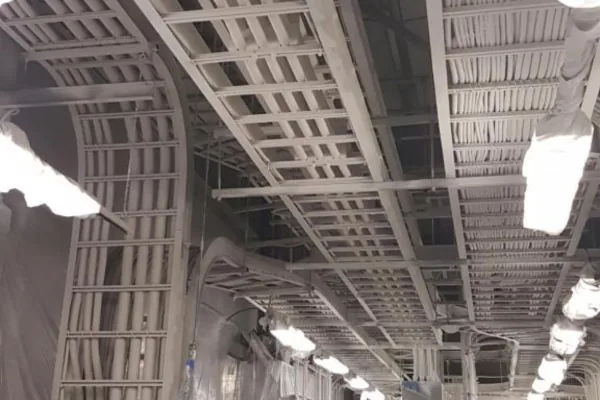
The building is finished. Handover is two weeks away. The Civil Defense inspector walks the electrical room, looks up at the cable trays, and asks a question nobody on site can answer: what was applied to these cables, and where is the record?
That moment is expensive. Not because coating cables is difficult, but because doing it properly after everything is installed, ceilings are closed, and the client is waiting costs far more than doing it during the fit-out.
This article explains where cable coating fits into fire safety compliance in the Kingdom, what an inspector is actually looking for, and how to avoid the paperwork problems that delay approvals.
What Civil Defense Is Really Checking
Civil Defense approval is not a single test. It is a review of whether the fire protection on site matches what was approved on the drawings and in the project specification.
For passive fire protection, that generally means three questions:
- Was the right material used?
The product on site should be the one named in the approved submittal, with data sheets and approval evidence to match. - Was it applied correctly?
Coverage, film thickness, and surface preparation determine whether the material performs at all. - Can you prove it?
Inspection records, photographs, and material traceability are what turn “we did it” into something an inspector can accept.
The third point is where most projects lose time. The work was done, but nobody documented it, and reconstructing the evidence afterwards is slow.
Where Cable Coating Fits In
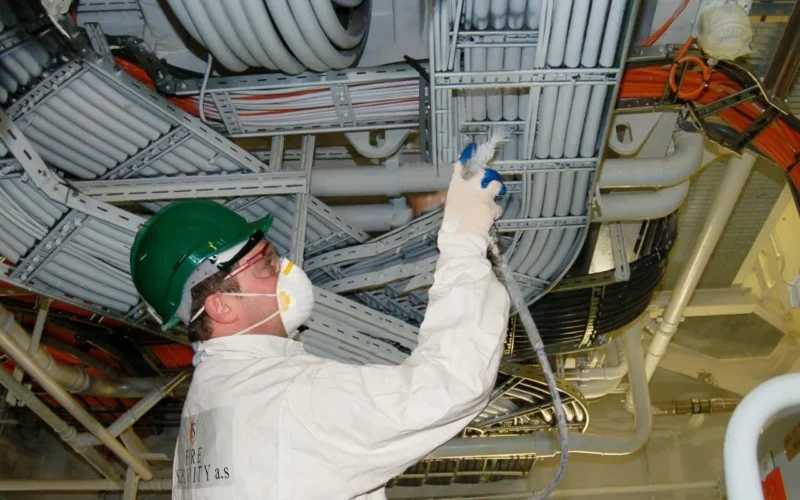
Cable coating is a passive fire protection treatment applied to installed electrical cables. Under heat it expands into a char layer that slows flame propagation along the tray and helps critical circuits stay operational longer.
It matters for compliance because cable routes run through fire-rated compartments. A wall may be rated correctly and the firestop sealing may be perfect, but if the cable run itself carries fire along the tray into the next zone, the compartmentation has effectively failed.
One clarification worth making: coating cable is not a substitute for firestop sealing at penetrations, fire-rated cable routes, or barriers. Inspectors look at the whole fire path. Coating one part of it while leaving a gap at the wall penetration does not pass.
Why the Requirement Varies From Project to Project
There is no single answer to “does my building need cable coating.” The requirement comes from the approved fire strategy, the project specification, and the building’s occupancy and risk classification.
A data centre, a hospital, a refinery, and a retail unit are not assessed the same way. The document that governs your project is the approved design and specification — that is what the inspector compares the site against. If the specification calls for cable fire protection and the site does not have it, the gap is clear regardless of any general rule.
The practical implication: check the specification early. Discovering the requirement at the inspection stage is the expensive version.
Common Reasons Projects Fail on This Point
- Unapproved material substituted on site. A similar product was cheaper and available. The submittal says something else.
- Film thickness below specification. Material was stretched to cover more length. The coating is present but not to the thickness it was tested at.
- Poor surface preparation. Coating applied over dust or oil loses adhesion, and inspectors do notice peeling.
- Coverage stops at the tray. Glands, junction boxes, and penetration points left untreated.
- Missing records. No thickness readings, no photographs, no delivery documentation for the material.
- Sequencing too late. Cables coated after ceilings and services are closed, making full coverage physically impossible.
What to Check Before Appointing a Cable Coating Company
Before awarding the work, ask for:
- Product submittal documents for the exact material proposed, with approval evidence you can put in front of the consultant and Civil Defense.
- A method statement covering surface preparation, application, film thickness, and curing in your site conditions.
- A clear inspection and documentation plan — what will be recorded, at what stage, and in what format.
- A site survey before pricing. A quotation issued without walking the cable routes is an estimate that will move.
- Scope coverage across the full fire path, including firestop sealing at penetrations, so responsibility does not split between two contractors at exactly the point where fires spread.
A contractor who treats documentation as an afterthought will pass that problem to you at inspection.
How We Support Projects in the Kingdom
We provide cable coating services in Saudi Arabia for industrial facilities, power plants, data centres, and commercial buildings — from cable route survey through application to handover records. Alongside coating cable, we deliver related passive fire protection scopes including firestop sealants and mortars, fire-resistant boards and wraps, and structural fireproofing, so one team is accountable for the complete fire path rather than a section of it.
Material supply and application are handled together, which keeps the product that was approved and the product that goes on the cable the same thing.
Getting Ahead of the Inspection
Compliance problems with cable fire protection are rarely about the coating itself. They are about the wrong material, the wrong thickness, or missing evidence — all of which are decided months before the inspector arrives.
Read the specification early, appoint a cable coating company that documents its work, and sequence the application while the trays are still accessible.
If you have an inspection coming up and want to know where your cable routes stand, a site survey is the practical first step. Our team can walk the project with you and identify the gaps while there is still time to close them.
Frequently Asked Questions
Does Civil Defense specifically require cable coating?
It depends on the project. The requirement comes from the approved fire strategy and project specification for your building type and risk level, and that is the document the inspector compares the site against. Check the specification rather than assuming a general rule applies.
What documentation should I keep for a cable coating job?
Material data sheets and approval evidence, the approved method statement, delivery records showing the product used, film thickness readings, and dated photographs of the coated routes. Missing records are a common cause of delay at inspection.
Can cable coating be applied after the building is finished?
Physically yes in accessible areas, but coverage is often incomplete once ceilings, ducting, and other services are installed. Applying it during the fit-out stage is both cheaper and more likely to pass.
What happens if the wrong product was used?
The usual outcome is a request to demonstrate equivalence with proper documentation, or to remove and reapply the approved material. Substituting without a formal approval is the more expensive route.
Is firestop sealing enough on its own?
No. Firestopping seals openings where cables pass through walls and floors. Coating protects the cable along its route. A fire that travels along an uncoated tray reaches the next compartment even when the penetration is sealed correctly.
Passive fire protection supplier and specialist contractor for electrical cable systems, based in Riyadh. Cable coating materials and application, firestop sealants and mortars, fire-resistant boards and wraps, and the technical documentation that goes with them.
Request a quotation
Send the cable schedule, tray routes, the fire rating required and any drawings. We propose the coating system and loading rate, supply the test and specification documentation, and price supply and application.